
Jump to a section:
TMS ·
Start Simple ·
Duplicates ·
Books & Paper ·
Sentimental Items ·
Wires Test ·
Amazon Boxes ·
Kitchen Calm ·
Tupperware ·
Unopened Good Stuff ·
Quick Checklist
TMS: Too Much Stuff (and Why We All Have It)
I use a simple term: TMS. Too. Much. Stuff.
I don’t like labels. I don’t like shaming. What I see is this: we like our things. We buy things, we store things, we keep things “just in case.” And because we have too much stuff, it can feel overwhelming—so we avoid it. And when we avoid it? The stuff multiplies.
The good news: there’s a way out. It doesn’t require perfection. It just requires a little honesty… a little momentum… and a simple system you can repeat.
Start Simple…Simply Start (Yes, Again)
I’m going to say this as many times as needed because it’s the difference between success and quitting:
Start simple… simply start.
Do not begin with the worst space in your home. Don’t start with the garage that hasn’t been touched in 15 years. Don’t start with the attic. Don’t start with the room that makes you want to close the door and pretend it doesn’t exist.
Start with something small: one laundry shelf, one kitchen cabinet, one nightstand drawer, one junk drawer (you know the one).
Small success builds momentum. Momentum builds confidence. Confidence builds action. And that’s one of the biggest benefits of decluttering your home—you start believing you can actually do it.
The Duplicate Problem: WD-40 and 47 Toothbrushes
One of the funniest patterns I see is what I call “the duplicate collection.” Here’s how it happens:
- You can’t find something.
- So you buy another one.
- You put it somewhere “safe.”
- Later… you can’t find it again.
- So you buy another one. And another one.
WD-40 is a classic. People collect it like it’s going out of style. And the irony? It’s designed to stop rust—yet you’ll find an old rusty can under the sink that’s been there for 15 years “just in case.”
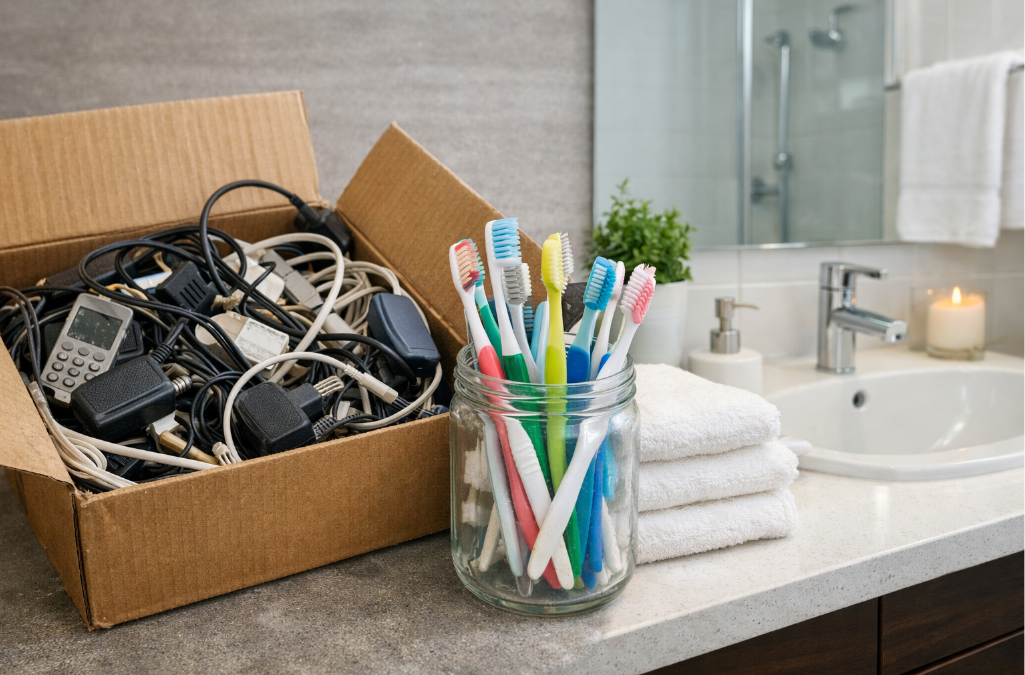
And yes… toothbrushes. Even if you have a house of ten people and five guests a week… you still don’t need 47 toothbrushes.
The point isn’t the toothbrush. The point is the pattern: we keep more than we need because we can’t find what we already have. That’s not a “stuff” problem. That’s an organization problem.
When you organize your home, duplicates reduce naturally because you stop rebuying what you already own.
Books and Paper: Are They Wisdom…or Trophies?
Let’s talk about books. And paper. And the binders and notes we keep because “it was a great seminar.”
Many people have books they don’t read, don’t open, and don’t even know why they’re keeping. They become trophies—and sometimes guilt.
So here’s the question: do you go back to that book again and again? Or is it sitting there gathering dust, taking up space, and quietly making you feel bad?
Keep the books you truly love and actually use: reference books, art books, coffee table books, the ones that bring you joy. But go through your shelves honestly. If seminar notes from 1994 no longer serve you, let them go. Donate to libraries, schools, or donation centers.
Quick trick: open the book, flip through the pages, “flutter” it a bit. It wakes it up, knocks off dust, makes it feel alive again. Then decide: keep or donate.
Sentimental Items: Keep the Memory, Not the Mountain
Some items aren’t replaceable: your child’s artwork, a handwritten prayer, a special card, a graduation photo. These matter. I respect that.
But here’s the thing: if those items are buried in bins, they aren’t being appreciated. They aren’t getting light of day.
A modern solution that works beautifully: take digital photos. Photograph the prayer card. Snap the artwork. Create a digital album. Print a few favorites and frame them later. This is how you declutter your home without losing what matters—you preserve the memory and release the bulk.
“Just in Case” Clutter: The Wires Test
Almost every home has a box of old wires, remotes, and electronic odds and ends. People keep them because they think they might need them someday.
Here’s my test—one question:
Is everything electronic in your house working right now?
If your blender, TV, toaster oven, air fryer, and computer are all working… then why are you saving 25 wires that connect to nothing?
“Just in case” becomes clutter when it has no matching purpose. Toss outdated cables, recycle what’s appropriate, and suddenly you get space back—physical space and mental space.
That’s a big part of how to get rid of clutter: stop saving problems you don’t currently have.
Amazon Boxes: The Cardboard That Ate the Living Room
I’ve walked into homes where the floor is covered with empty Amazon boxes. Why do people keep them? They think they’ll need them for packing. They think they’ll use them later. They think they provide security.
But in reality, it’s cardboard taking up your living space. Recycling them can clear a huge amount of space in minutes—and it doesn’t require heavy emotional decision-making.
Sometimes decluttering is not complicated. Sometimes it’s simply: stop saving trash.
The Kitchen: The Heart of the Home (So Let’s Keep It Calm)
The kitchen is where people gather. You make food, pour drinks, talk, laugh, and live. If you want one area that immediately improves your home environment, the kitchen is a great place to start.
Reset the counters
Clear the counters. Take everything off—everything. If you have multiple counters, do one at a time so you don’t overwhelm yourself. Then wash it down. Soap and water. Disinfectant. Whatever you like.
Now you’ve got a brand new canvas.
The goal is not “nothing ever lives on the counter.” That’s not realistic. People drink coffee. People use appliances. But here’s the key:
Place items deliberately. Not randomly.
And here’s an image I love: a clean countertop should feel like the ocean horizon. There’s something calming about that clean line. Let your counters replicate that serenity.
Tupperware, Storage Containers, and the Great Lid Mystery
Now let’s talk about the cabinet everyone avoids: storage containers. Lids that don’t match anything. Bottoms with no tops. A whole plastic ecosystem.
Here’s what I like to do: a “fashion show” in the kitchen.
Match tops with bottoms. And I have one rule:
If the top and bottom don’t match by the end of the session, they’re probably not going to match by magic later.
So we let them go. We nest what we keep. We stack properly. And suddenly you create 20–30% more space without renovating anything.
One of the best home organization tips is this: you don’t always need more storage. You need less chaos.
Unopened “Good Stuff”: Use It or Gift It
Another common situation: you bought something good—nice containers, nice kitchen items, nice clothes—and you never opened them. They sit in plastic for years because they’re “new,” because you’re saving them.
But saving the good stuff for “someday” is a habit worth breaking. Take the tag off. Open the container. Use the good china. Use the nice stemware. What are we saving it for?
If you truly won’t use it, gift it. Donate it. Let someone else enjoy it.
The Real Goal: Stop the Beating Up
Decluttering is not about beating yourself up. Stop the negative messaging. Stop the “I don’t have time.” Stop the excuses that turn into shame. Start believing in yourself.
A home that’s clear of clutter reduces stress, supports mental clarity, and helps you feel lighter and more purposeful.
Clear the clutter… clear the mind.
Quick Start Checklist: How to Declutter This Week
- Start with one drawer or one cabinet (keep it small).
- Remove everything and wipe it down.
- Toss obvious trash immediately.
- Create a donation bag (a white bag works great).
- Put back only what belongs and what you actually use.
- Repeat once per week—small wins add up fast.
Recent Comments