
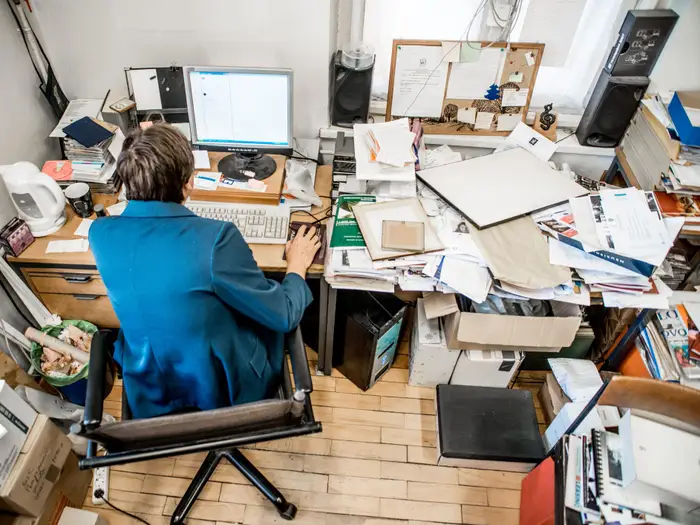
You know what I’m talking about.
You walk past the dining room table and there’s a stack. You glance at your desk and there’s another stack. Your kitchen counter has a stack. And somewhere probably in a drawer or shoebox—there’s another pile you’ve been meaning to go through for the past three years.
Paper clutter is sneaky like that.
It doesn’t look like a big problem at first. One envelope here, one magazine there. But over time, it turns into what I like to call TMS Too Much Stuff. And when it comes to clutter in the home, paper is one of the biggest contributors.
The funny part? Most of it doesn’t matter at all.
Why Paper Clutter Builds Up So Fast
Paper has a strange emotional power over us.
For some reason, when we see something printed, we think it must be important. A bill? Important. A receipt? Better keep it. A coupon? Maybe we’ll use it. A postcard about a house sale down the street? That might be useful someday.
So what do we do?
We put it aside “for later.”
And later becomes tomorrow. Tomorrow becomes next week. Next thing you know, you have a dining room table covered with stacks of paper you’re afraid to touch because it feels overwhelming.
Sound familiar?
The reality is that paper clutter isn’t really about paper. It’s about decisions. Every piece of paper asks you a small question: Do I keep this or get rid of it?
When you postpone that decision, the pile grows.
The First Rule of Paper Decluttering: Stop the Madness Early
Here’s the simplest decluttering tip I can give you when it comes to paper: deal with it immediately.
When the mail arrives, stand by the recycling bin and sort it right there.
- Advertising postcards? Recycle them.
- Coupons you’ll never use? Recycle them.
- Credit card offers? Recycle them.
If you don’t have an air duct cleaning system in your home, you probably don’t need the flyer advertising air duct cleaning. And those giant real estate postcards showing a smiling agent and a “Just Sold!” banner? Unless you’re selling your house today, you probably don’t need those either.
The key is simple: don’t let it land on the table.
Once paper lands on a surface, it tends to stay there. Paper piles are like snowballs rolling downhill—they grow bigger without any effort at all.
Magazine Clutter: The Recipe Box Problem
Magazines are another classic source of paper clutter.
Years ago, magazine subscriptions were exciting. A new issue would arrive each month filled with beautiful photography, recipes, decorating ideas, travel stories, and helpful tips. The trouble begins when we keep them all.
You might have a stack of cooking magazines because one article has the perfect sweet potato recipe. Or a stack of home magazines because there’s a decorating idea you love. But let me ask you something: do you really need the entire magazine for that one page?
Probably not.
A simple solution is to remove the page you actually want and recycle the rest. That way, you keep the valuable information without storing pounds of paper you’ll never look at again.
I see this all the time in kitchens. People have shoeboxes filled with recipes clipped from magazines decades ago. They’re saved out of loyalty perhaps they came from Mom or Grandma but nobody can actually find a recipe when they need one.
These days, almost any recipe ever created can be found online in seconds. So if you’re holding onto stacks of magazines for recipes, it might be time to rethink that storage strategy.
Business Cards: The Two-Second Rule
Another interesting form of paper clutter is the humble business card.
If you attend networking events, conferences, or professional meetings, chances are you’ve collected dozens maybe hundreds over the years.
Most people store them in rubber bands, drawers, or desk organizers. But how often do you actually use them?
Here’s my two-second system for business cards. Pick up a card and ask yourself one question: Am I ever going to contact this person again?
- If the answer is no toss it.
- If the answer is maybe keep it.
- If the answer is yes keep it and organize it.
You can store cards alphabetically, by industry, or by when you met the person. The key is simply reducing the pile. And here’s the bonus: going through old business cards can remind you of people you meant to reconnect with.
The Myth of Saving Paper for Seven Years
Many people believe they must keep financial paperwork for seven years. It’s a common piece of advice that’s been passed around for decades. But the world has changed.
Banks, credit card companies, and even the IRS maintain extensive digital records. In many cases, your information is stored electronically far longer than you would ever keep paper copies.
According to modern guidance, three to four years is often more than enough for most personal financial records. Beyond that, the paper is usually unnecessary.
Of course, you should always check with your accountant about your specific situation. But if you’re storing tax returns from 15 years ago, you may be holding onto paper that no longer serves any purpose. And that’s what clutter clearing is really about letting go of things that no longer serve you.
The Receipt Trap
Receipts are another form of paper that seems to multiply overnight.
Every purchase comes with one: groceries, gas, clothing, doctor visits they all generate little slips of paper that end up stuffed into wallets, purses, or desk drawers.
But here’s the question: what are you actually saving them for?
Most receipts already exist digitally through your bank or credit card statement. If you really needed to verify a purchase, you could usually find it in your online account history. That doesn’t mean receipts are never important sometimes they are for returns or taxes but saving every single one indefinitely is rarely necessary.
When you clean out your wallet or purse, you might discover receipts that are years old. At that point, they’re simply paper clutter draining your energy.
The Purse and Wallet Test
Speaking of wallets and purses, they can become miniature storage units if we’re not careful.
I often ask clients to empty their purse completely onto the table. The results can be surprising: old receipts, expired coupons, membership cards, loose papers, and sometimes even things they forgot they had.
The simple act of emptying everything out helps you see what you’re actually carrying around every day. Once you remove what’s unnecessary, your purse becomes lighter—both physically and mentally.
The same applies to wallets. If yours is bulging with receipts and outdated cards, it may be time for a quick purge.
Photograph Clutter: A Different Kind of Paper
Not all paper clutter is disposable. Photographs are different. They hold memories, family history, and personal stories. But even photographs can accumulate beyond what we can realistically appreciate.
Many people store thousands of old photos in shoeboxes. If you’ve ever opened one of those boxes, you know what happens next. You start looking through the pictures and suddenly you’re reliving vacations, birthdays, and family moments from decades ago.
That’s actually a wonderful thing. But here’s a small suggestion: you don’t need to keep 384 pictures of the same sunset. Choose the five best ones. Keep those. Let the rest go.
By doing that, you’re not erasing memories you’re highlighting the ones that matter most. And you’ll make your photo collection far easier to enjoy.
Why Decluttering Paper Clears Your Mind
Paper clutter is more than a physical problem. It’s a mental one.
Every pile represents unfinished decisions. When you walk past it, your brain registers that something still needs to be handled. Multiply that by ten piles around your home, and suddenly your mind feels overwhelmed.
That’s why decluttering paper can be so powerful.
When you sort through those stacks and reduce them to what truly matters, something shifts. The room feels lighter. Your focus improves. The mental noise quiets down.
It’s not just about organization it’s about clarity.
A Final Reminder: Don’t Beat Yourself Up
If you have paper piles around your house, you’re not alone. Busy lives create clutter. Kids, work, mail, school paperwork, and bills it all adds up quickly.
The important thing is not to criticize yourself. Instead, start small.
- Pick one pile.
- Sort it for ten minutes.
- Recycle what you don’t need.
Progress doesn’t happen all at once. It happens one small decision at a time. And every piece of paper you release creates a little more space not just in your home, but in your mind.
Because at the end of the day, the goal is simple.
Clear the Clutter…Clear the Mind.™
Recent Comments